
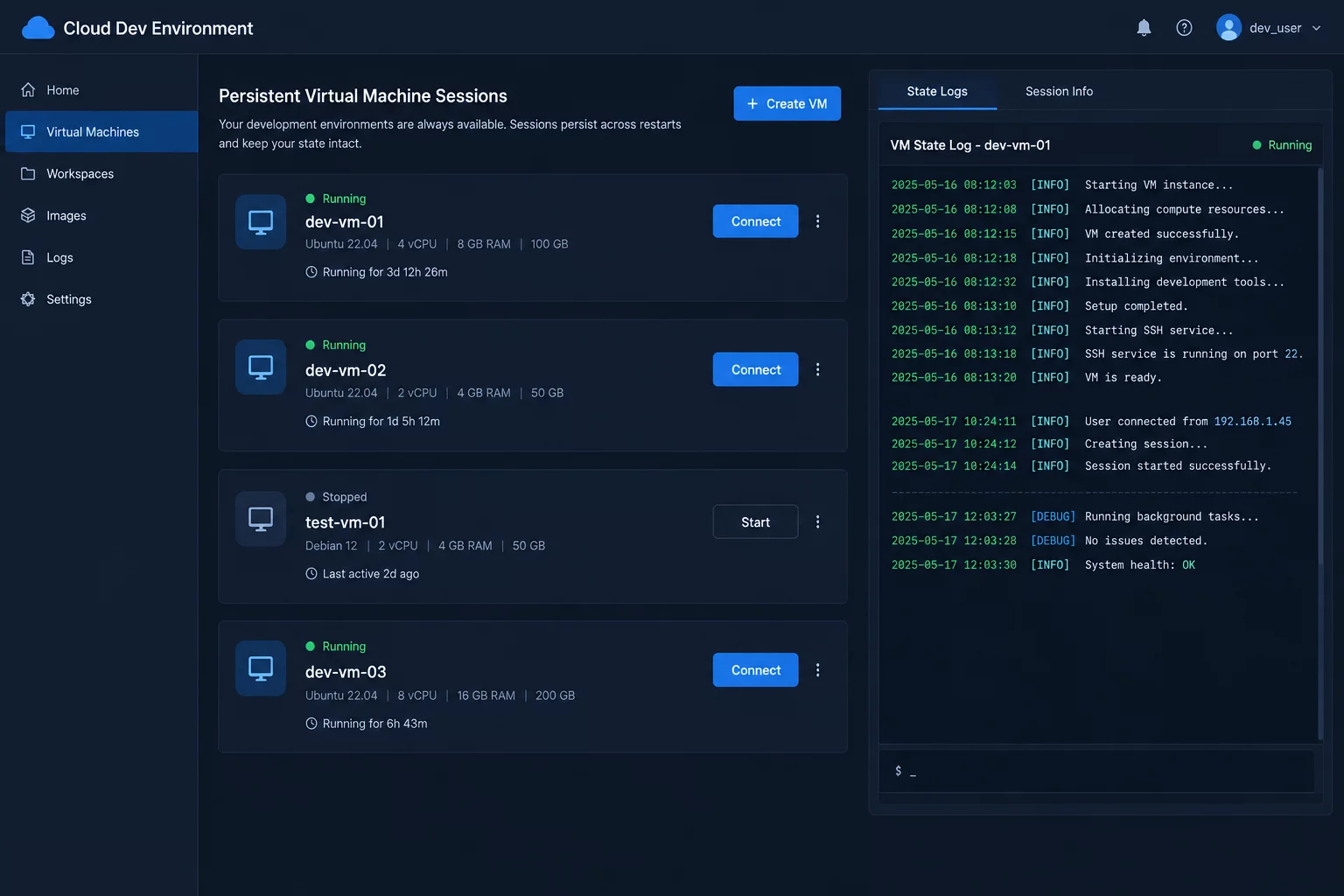
Modern remote workspace engines face an engineering trade-off between the security of ephemeral execution sandboxes and the requirement to preserve developer state across reboots. In boxd workspaces, this conflict is resolved by decoupling immutable root partitions from stateful user directories through hardware-assisted hypervisor mounts. By standardizing where project artifacts, daemon sockets, and shell runtimes live, teams gain predictable warm-boot times while preventing unintentional disk growth.
Mount Hierarchy and Directory Demarcation
Inside every boxd virtual instance, the root filesystem boots as a read-only disk image sourced from an immutable base template. Ephemeral package updates, compiler temporary outputs, and container runtime sockets resolve to a fast in-memory tmpfs mount that automatically clears during tear-down. This setup guarantees that poisoned system binaries or unintended kernel module modifications cannot persist into the next development sprint.
User files and persistent working trees reside strictly under dedicated mount branches mapped directly through virtio-fs daemons on the host hypervisor. This clean boundary allows engineers to configure precise backup snapshots and background deduping without locking the entire running machine. The following directory specifications govern this partitioning:
- Strict segregation of user home directories under /persist/home using user-space overlay layers.
- Automated sync loops for terminal history and editor cache targeting the /persist/state partition.
- Host-side dirty-page commit throttles enforcing journal integrity without stalling IDE indexing jobs.
A reliable cloud workspace treats virtual compute as entirely disposable while honoring every byte written to the developer's project directory as durable host storage.
Snapshot Policies and Checkpoint Serialization
Suspending a virtual workspace requires serializing guest memory alongside pending block write requests without corrupting active Git indices or running database engines. The boxd architecture achieves this with a two-phase freeze handler. First, a guest guest-agent trigger executes filesystem freeze commands (fsfreeze) across mounted persistent trees. Once file tables quiesce, the hypervisor writes memory delta snapshots to non-volatile local NVMe scratch pools.
Resuming the instance reverses this pipeline in under 800 milliseconds. Because volatile runtime segments discard cleanly upon shutdown, resume operations rebind the guest to refreshed base images while reattaching the persistent volume. Developers return to precisely the same terminal tabs, open file pointers, and uncommitted edits without carrying the cumulative software bloat that routinely degrades long-lived local development laptops.
Virtual Machine Persistence Architecture FAQ
The hypervisor provisions an immutable root image paired with a volatile tmpfs overlay for system operations, while mounting user workspaces through dedicated virtio-fs endpoints connected to persistent host block storage.
Before committing an instance state snapshot, the hypervisor guest-agent issues synchronous fsfreeze directives to flush block journals and barrier commands, ensuring file descriptor integrity across re-attaches.
Quotas bind strictly to the allocated persistent overlay pool through thin provisioning limits, letting users spawn lightweight worktree clones without multiplying raw physical disk usage.