
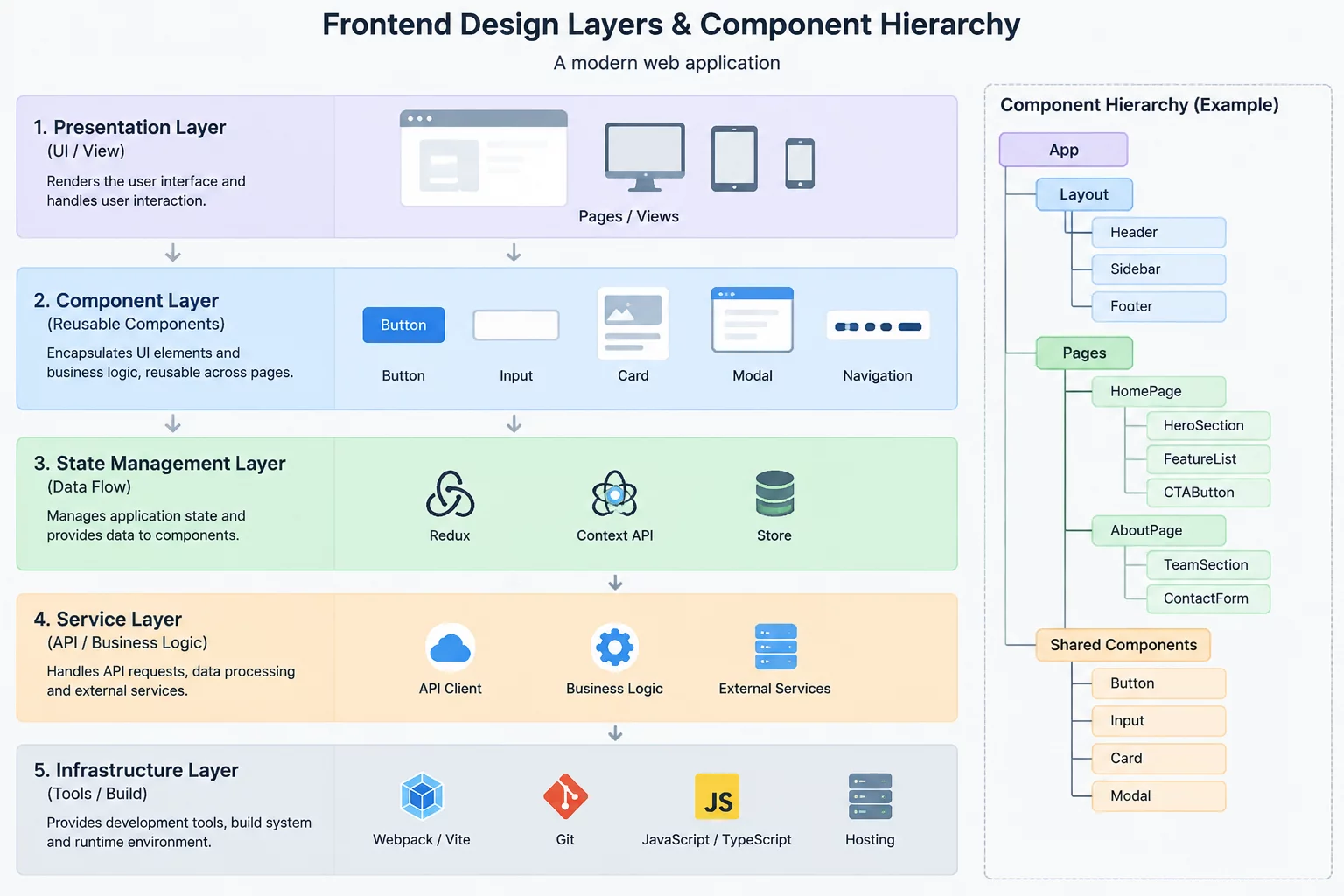
Scaling complex frontend applications across multiple engineering teams almost always triggers architectural friction. What begins as a convenient folder of components rapidly deteriorates into circular imports, unpredictable side effects, and entangled state management. Feature-Sliced Design (FSD) resolves this systemic maintenance burden by establishing a clear physical hierarchy where code lives strictly according to its role in business logic rather than generic technical categorizations.
Deconstructing the Seven Structural Tiers
At the foundation of Feature-Sliced Design is an immutable rule of import direction: modules on higher layers may consume code from lower layers, but never in reverse. The root application directory divides cleanly into app, processes, pages, widgets, features, entities, and shared. This unidirectional gravity prevents cyclic dependencies before they can manifest, guaranteeing that lower-level primitives remain wholly agnostic of parent business flows.
Within each tier, code groups into discrete business slices—for example, user-profile, catalog-filter, or payment-checkout. Every slice contains designated segments such as ui, model, api, and lib to partition data contracts from visual elements. Crucially, a slice exposes its contracts solely through an explicit public index.ts interface, treating internal file paths as private module details.
- Strict Layer Precedence: High-order widgets and features consume low-order entities without upward reference leaks.
- Public API Encapsulation: Sub-segment files remain strictly internal to safeguard against deep cross-boundary imports.
- Zero Horizontal Coupling: Peer slices on the same layer cannot import from one another, removing cross-domain lock-in.
Directory architecture is not merely an aesthetic choice of folder naming. It represents the immutable physical boundary preventing revisions in one business domain from unexpectedly breaking another.
Automating Governance with Boundaries and Linters
Discipline alone rarely preserves architectural integrity across dozens of contributors. Successful implementations pair the Feature-Sliced hierarchy with automated build-time constraints using eslint-plugin-boundaries or specialized FSD linting plugins. These tools read folder paths and fail continuous integration pipelines whenever an entity attempts to access a page, or when horizontal imports breach slice isolation.
By enforcing this standard, large development teams eliminate guesswork during feature delivery and code reviews. Engineers can determine the exact scope, reusability, and side-effect footprint of any file simply by looking at its location on disk. The outcome is a resilient codebase that scales cleanly through years of product evolution.
Frequently Addressed Architecture Questions
FSD strictly forbids horizontal coupling between peer entities such as user and order. When an interaction requires data or components from multiple entities, that composition must be moved up into a feature or composite widget slice. This maintains single-purpose autonomy within the entity tier.
The shared layer contains only domain-agnostic foundations. This includes design system UI primitives (buttons, dialogs, icons), general HTTP clients, internationalization helpers, and basic formatting utilities. Any file referencing business concepts belongs in higher layers.
FSD delivers maximum return on investment when projects grow beyond 15–20 engineers or when modular ownership becomes obscured by tangled code. For short-lived experiments or simple single-developer web apps, standard feature directories may suffice, but FSD excels in medium-to-large enterprise platforms.