
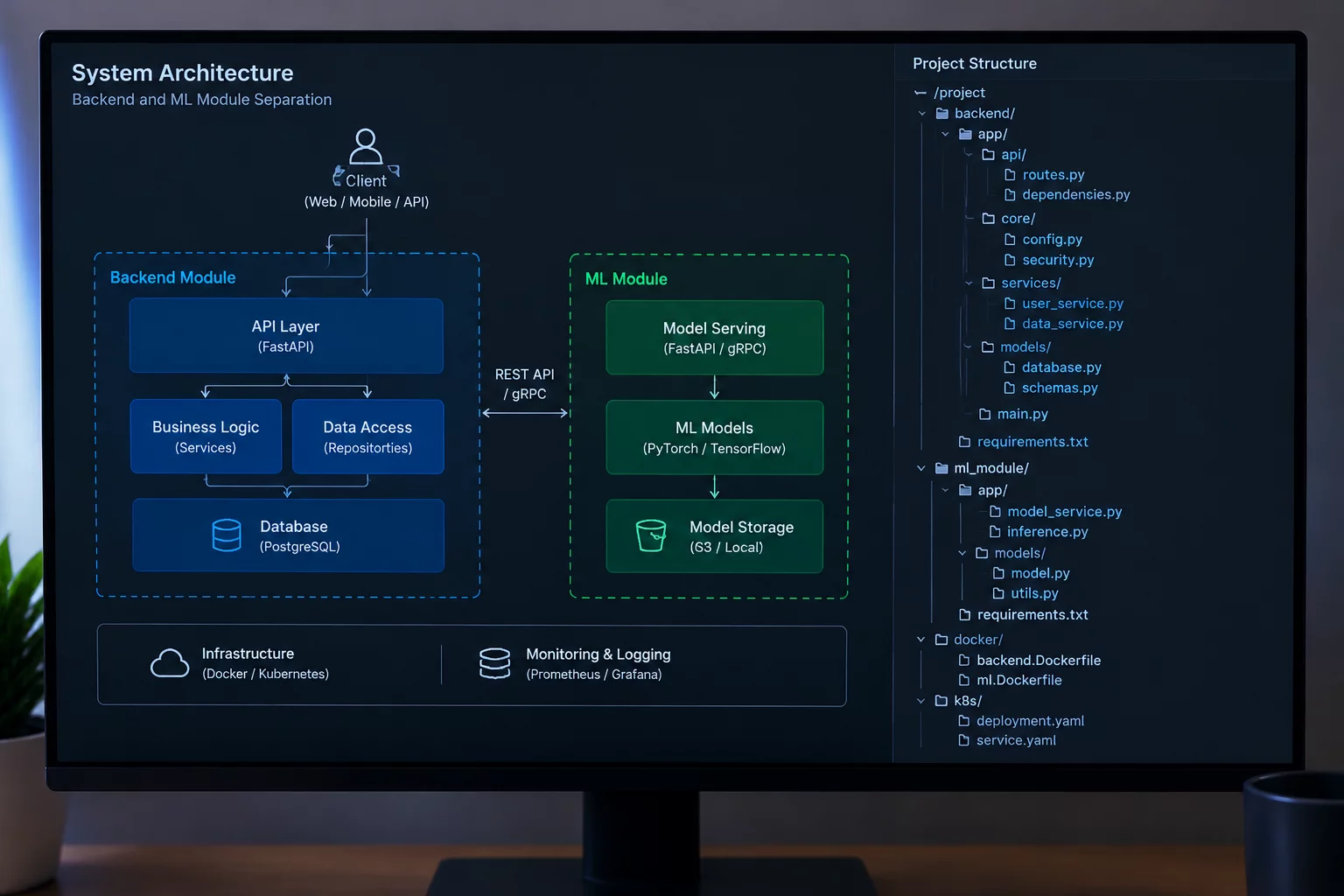
Software repositories that attempt to unify backend API services with machine learning workflows routinely suffer from architectural erosion. Training notebooks clutter domain logic, experiment artifacts pollute deployment manifests, and transient weight checkpoints accidentally slip into version tracking. Creating a clean folder topology prevents these structural collisions, ensuring that model training, data ingestion, and client-facing endpoints evolve independently without breaking deployment pipelines.
Segregating Data Science Workspaces from API Runtime
In conventional monorepos, engineers frequently place training scripts directly alongside HTTP routers, resulting in bloated Docker images and tangled dependency trees. A clean architectural separation assigns distinct top-level directories to domain services (src/api), inference engines (src/inference), and training routines (experiments/ or pipelines/). Each boundary maintains strict unidirectional imports: serving layers depend on compiled model artifacts, never on the training code that generated them.
Data engineering pipelines require specialized persistent storage hooks. Storing raw datasets, transformed feature stores, and evaluation metrics inside local code directories creates severe security risks and disk bloat. Instead, directories under data/ or artifacts/ must act solely as ephemeral local mounting points backed by automated .gitignore rules, while actual dataset provenance remains tied to remote object storage clusters.
- Isolated
src/domain/housing pure business logic without framework or machine learning dependencies. - Decoupled
pipelines/containing reproducible ETL scripts and hyperparameter tuning configurations. - Dedicated
models/registry/managing serialized ONNX, TensorRT, or PyTorch weights with hash manifests.
When training pipelines and production inference share arbitrary utility scripts inside a catch-all folder, reproducibility collapses the exact moment an experimental library update alters runtime numerical precision.
Managing Artifact Lifecycle and Environment Parity
A dependable backend and machine learning layout organizes configurations into layered profiles. Environment definitions placed in config/environments/ distinguish local development from distributed GPU cluster execution. Meanwhile, model checkpoints pass through a staging lifecycle within artifacts/models/{model_id}/{version}/, where training runs write evaluation summaries alongside binary weights prior to registration.
Production backend handlers import these versioned models exclusively through abstraction layers located in src/adapters/model_loader.py. This design pattern guarantees that API controllers remain oblivious to the underlying serialization mechanism, whether loading quantized weights from disk or streaming tensors from an encrypted cloud bucket.
Architectural Folder Inquiries & Best Practices
Exploratory notebooks belong in an isolated notebooks/ directory at the repository root, segregated into numbered stages such as 01_exploration and 02_feature_validation. They must never be referenced by backend service modules or packaged into production container images.
Maintain a designated models/checkpoints/ folder covered by .gitignore and .gitattributes. Use Git LFS or direct remote artifact storage tools like DVC or MLflow to manage weight binaries, keeping only lightweight metadata manifests and checksum files in source control.
Decoupling prevents heavy data processing libraries like Spark, Polars, or Ray from swelling runtime microservice instances. Backend APIs require minimal latency and lightweight footprints, while data pipelines demand compute-intensive batch execution environments with completely different scaling profiles.