
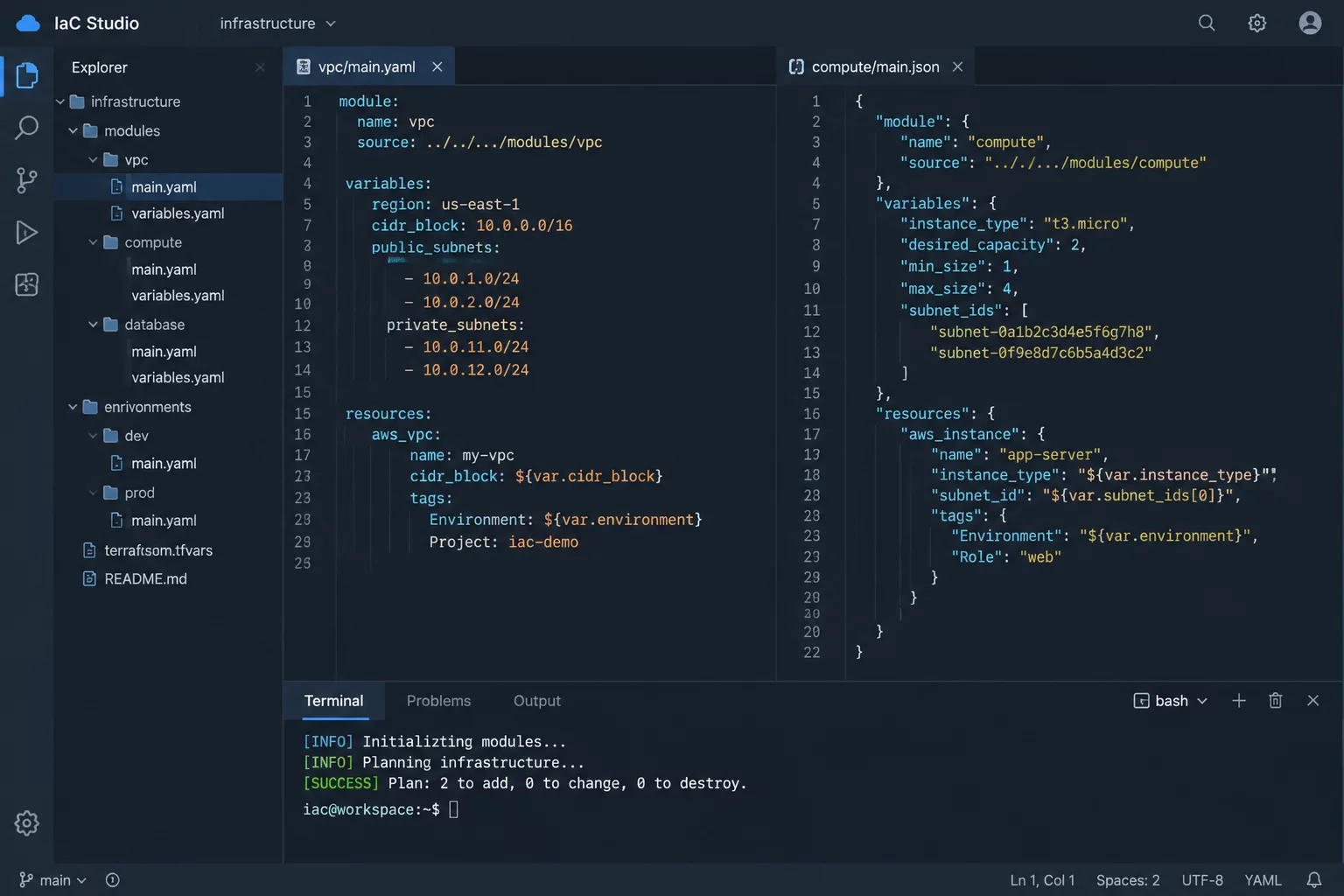
Modern cloud deployments collapse into unmanageable sprawl when configuration scripts treat large environments as single monoliths. Applying strict modular standards establishes clean folder separations, isolated blast radiuses, and composable building blocks that cloud engineering teams can evolve independently across hybrid providers.
Structural Decomposition and Stack Partitioning
Every reusable module must act as a well-defined contract. The root configuration consumes parameter inputs through validated variables, while outputs expose only strictly necessary endpoints and telemetry pointers. In this hierarchy, infrastructure units remain completely agnostic of whether they are invoked within development sandboxes or production clusters.
Dividing infrastructure into tiered layers prevents accidental cross-resource destruction. A foundational networking tier hosts transit gateways and VPC peering, while separate platform tiers handle managed databases and Kubernetes node groups. Each layer runs under its own state lock, ensuring that updates to container clusters never execute lock requests against underlying foundational routing tables.
- Root module isolation strictly separates network topologies, database clusters, and edge ingress layers to prevent broad blast radiuses during state runs.
- Deterministic parameterization guarantees reusable environment overlays without duplicating configuration blocks across staging and production targets.
- Granular version pinning across internal registries protects shared operational assets from unverified upstream schema updates.
Infrastructure modules should mirror Unix philosophy: encapsulate a single logical resource cluster with distinct boundaries and export only verifiable telemetry outputs.
Decoupled State Storage and Environment Overlays
Effective directory structures maintain a sharp dividing line between generic module definitions and environment-specific live invocations. Generic code resides in a shared catalog repository with semantic version tags. Concrete environment directories merely consume these modules, supplying region parameters, sizing variables, and compliance labels without redefining resource declarations.
By enforcing thin root configurations in the live environments directory, teams cut down blast radius risks to small, verifiable plan outputs. Changes execute through automated pull request pipelines that inspect module diffs, execute static validation linters, and verify that cryptographic secrets pass through vault references rather than raw state text.
Architectural Inquiries & Deployment Standards
Hardcoding remote state dependencies couples separate stacks together, introducing race conditions and brittle pipelines. Relying on typed module parameters or service directory catalogs decouples state management completely.
Modules reference secret identifiers from encrypted vaults rather than storing plain values. The underlying runner fetches tokens at execution time through short-lived identities.
A common standard places re-usable component logic in a shared modules directory, while discrete live environments reference those modules via strict version tags from distinct directory roots.