
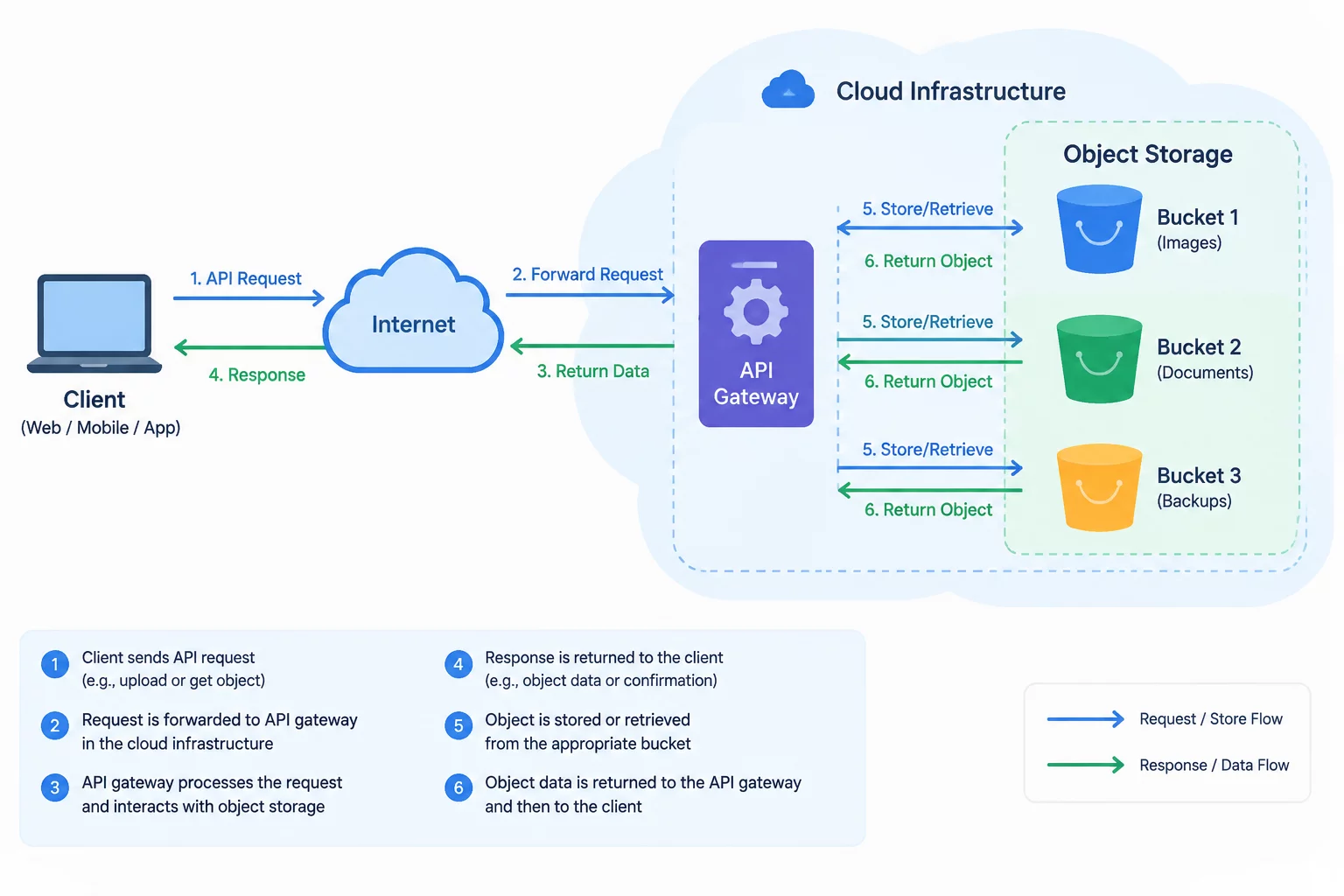
Data storage fees per gigabyte continue their steady downward drift across cloud hyperscalers, yet organizations regularly face jarring surprises on their infrastructure bills. The culprit rarely involves the raw gigabytes stored inside buckets. Instead, unoptimized transactional architectures where systems treat flat object namespaces as conventional POSIX directory trees generate tens of millions of billable API calls every single week.
Prefix Delimiters and the Multiplier Effect of Listing Requests
Underneath user interface abstractions, object stores provide no genuine concept of nested folders. Every target path is merely an alphanumeric string key stored inside a massive, partitioned index table. When software libraries simulate a directory walk by passing a forward slash as a delimiter, the remote endpoint performs sequential page scans. Providers bill these operations under high-tier Class A requests, typically capped at 1,000 keys per HTTP response envelope.
Automated crawler jobs, backup synchronizers, and analytical worker pools that repeatedly query deeply nested structures incur compounding transactional tolls. Traversing an archive of five million objects split across date-partitioned subkeys requires at least five thousand round-trip list operations per verification pass. Run that sweep hourly across dozens of worker nodes, and transaction invoices outstrip baseline storage retention costs within the first billing quarter.
- Partitioned prefix sharding to prevent index bottlenecks and reduce recursive delimiter walks
- Decoupled metadata registries such as DynamoDB or SQLite indices acting as query caches
- Client-side batch compaction merging tiny payloads into dense Parquet or tar formats prior to dispatch
If your software treats cloud object storage like a local filesystem mount, your ledger will pay for API transaction overhead long before raw capacity even registers on your dashboard.
Aligning Payload Dimensions with Provider Tiering Economics
Micro-object anti-patterns represent another significant financial drain. Emitting telemetry data, log snippets, or event records as discrete four-kilobyte objects triggers individual PUT and lifecycle tiering costs that easily dwarf the data value itself. Additionally, lifecycle transition policies to colder tiers, such as Infrequent Access or Glacier classes, assess both transition request fees and strict minimum billing durations that make sub-megabyte objects financially catastrophic.
Engineering robust storage patterns demands event-driven reactive architectures. Instead of continuous polling via LIST queries, decoupled messaging frameworks notify consumers of newly committed keys via pub/sub webhooks. Combining event-driven ingestion with local write-ahead buffers consolidates transactional traffic, cuts billable API invocations by more than ninety percent, and restores sanity to engineering department operating budgets.
API Economics and Bucket Key Taxonomy Clarifications
Cloud vendors bill storage requests under tier classifications where Class A actions like LIST and PUT carry rates orders of magnitude higher than passive data residency. High-frequency workers performing prefix scans repeatedly query index tables, accumulating substantial transactional line items even when returning minimal payload data.
When passing a delimiter such as a forward slash, the storage engine groups common prefix tokens to mimic subdirectories. However, the service still evaluates keys in lexicographical sequence across flat partition rings. Deeply nested key patterns force repeated sequential token exchanges, introducing notable latency and multiplying billable requests.
Aggregating streaming records into memory or scratch volumes until batches reach 16 to 64 megabytes creates an optimal balance. It reduces total write transactions by over 98 percent while staying comfortably above the cold-storage minimum capacity billing penalties enforced across AWS S3 and Azure Blob tiers.