
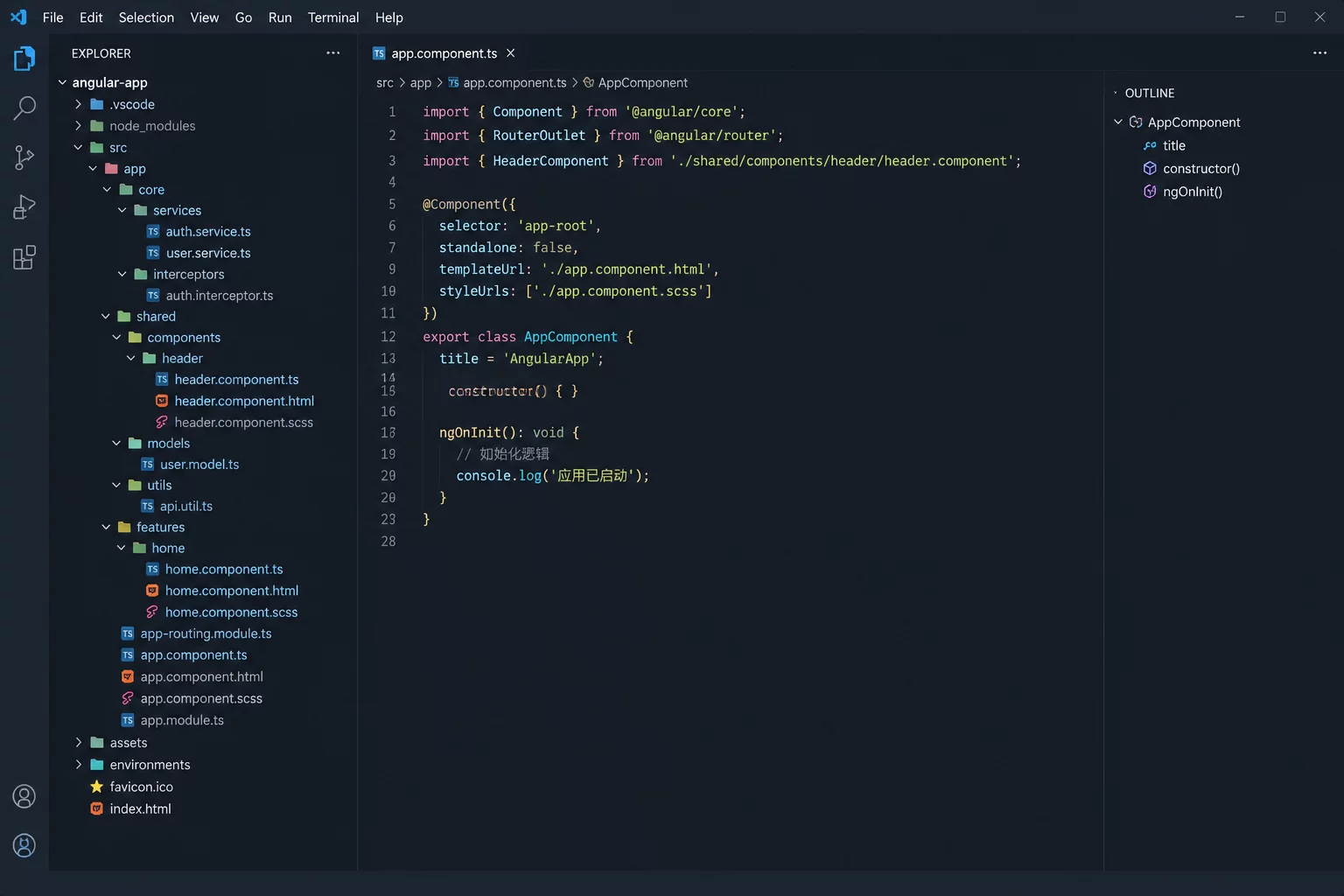
Scaling enterprise frontend codebases demands a rigorous folder taxonomy that balances feature isolation against code reusability. In modern Angular applications, transitioning away from monolithic shared folders toward autonomous feature slices ensures predictable dependency graphs, streamlined code reviews, and faster compilation cycles.
Anatomy of a Feature-Driven Directory Tree
In traditional Angular setups, developers often grouped files strictly by technical role, placing all components, services, and pipes into flat global directories. This pattern breaks down as teams grow beyond a dozen engineers. Organizing files by business domain—grouping the routing, state, UI components, and API integration belonging to a single capability—keeps cognitive load low and prevents cross-domain entanglements.
Within each feature directory, sub-packages clearly separate container components from presentation primitives. Services dedicated exclusively to fetching domain data reside directly beside the views consuming them, while truly universal elements live in isolated core utility packages with enforced linting boundaries.
- Isolated feature libraries containing dedicated route configurations and smart container components
- Strict lint rules preventing circular dependencies between peer domain directories
- Dedicated barrel exports limited to public API surfaces per vertical slice
Codebases degrade into tangled webs not because of framework constraints, but because directory boundaries failed to reflect actual business ownership.
Workspace Path Aliases and Standalone Boundaries
Standalone components completely revised how Angular applications assemble dependencies. With NgModules no longer acting as structural gatekeepers, file organization directly represents the physical architecture. Defining clean TypeScript path aliases within tsconfig.base.json lets developers consume domain models without traversing fragile relative dot-paths.
Enforcing strict directory taxonomy also supercharges build caching tools such as Nx or Turborepo. When change detection algorithms evaluate Git diffs against structured directory scopes, CI pipelines skip unaffected modules entirely, reducing pipeline execution times from fifteen minutes to seconds.
Architectural Standards & FAQ
Grouping by technical layer forces developers to hunt across distant directories for files that always change together. Feature slices localize domain logic, making refactoring, onboarding, and eventual module extraction significantly safer and faster.
Place design system primitives in an autonomous shared-ui library, and low-level TypeScript utilities in a core-util folder. Neither should ever import from domain feature slices.
Path aliases replace brittle relative paths with clean project references, while index.ts barrel files define an explicit public boundary, preventing internal implementation details from leaking outside the slice.