
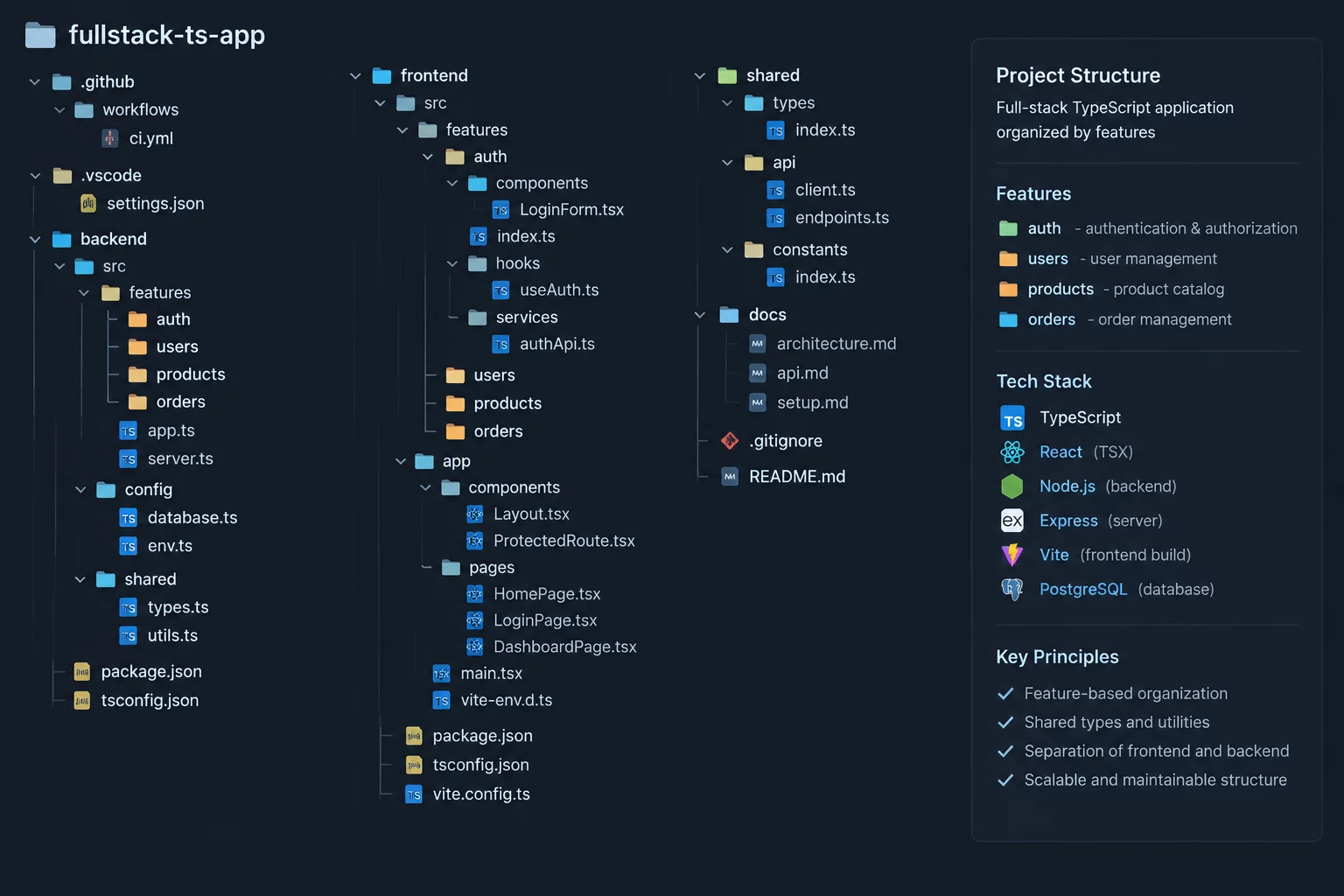
Traditional technical grouping segregates software into arbitrary silos like controllers, models, components, and reducers. When engineers update a single business requirement, they often touch files scattered across six distant directories. Feature-First architecture reclaims developer momentum by clustering code around autonomous product features, bringing server routines, client UI, database models, and validation logic into unified vertical folders.
Deconstructing the Friction of Layer-Based Directories
In large TypeScript teams, technical layering creates invisible friction. As applications scale beyond dozens of endpoints, developer onboarding suffers because new hires cannot map functional concepts directly to folder trees. Modifying an authentication workflow forces a contributor to browse through global utilities, detached interfaces, and distant presentation folders simultaneously.
Organizing files by feature establishes natural boundaries across the codebase. Inside each feature directory, an index file defines explicit exports, ensuring that external modules consume only approved interfaces. Private helper utilities, schema validators, and intermediate transforms stay securely concealed within their respective domain folders.
- Hermetic Domain Isolation: Each feature directory encapsulates database queries, RPC endpoints, and reactive view components without leaking unexported implementations.
- Zero Cross-Feature Bleed: Sibling folders interact solely through typed public index interfaces, preventing spaghetti cross-imports across business domains.
- Effortless Deletion & Refactoring: Deprecating an obsolete capability requires deleting one directory rather than pruning references across ten separate layers.
When codebase directory trees mirror actual business operations, context switching evaporates and architectural compliance becomes an effortless default.
Tactical Layout of a Full-Stack Feature Directory
A resilient feature module houses all artifacts required to deliver an isolated piece of user functionality. For instance, a billing feature directory contains checkout forms, Stripe webhooks, database access objects, zod validation schemas, and automated integration tests. Shared cross-cutting elements like design tokens or logging wrappers reside in a dedicated shared directory, leaving domain directories strictly autonomous.
To enforce boundary discipline, tooling like ESLint boundary plugins and TypeScript path aliases restrict illegal inward imports. Teams can safely scale development across multiple squads because code ownership aligns directly with root-level feature namespaces. This reduces merge conflicts and keeps compile times optimized through targeted module resolution.
Architectural Inquiries and Operational Best Practices
Foundational components such as unstyled primitives, HTTP transport clients, and math helpers reside in a top-level shared folder. A strict architectural rule dictates that the shared folder cannot import from any feature folder, ensuring no circular dependencies arise.
Teams configure linting boundary rules via eslint-plugin-boundaries or Nx workspace boundaries. These checkers inspect module paths during pull request builds, automatically failing if a module attempts to import non-exported private files from an adjacent feature.
Yes, feature folders directly mirror prospective independent npm packages. If a feature needs to be shared with a companion mobile app or external service, migrating the entire folder into an isolated workspace package requires minimal code reorganization.