
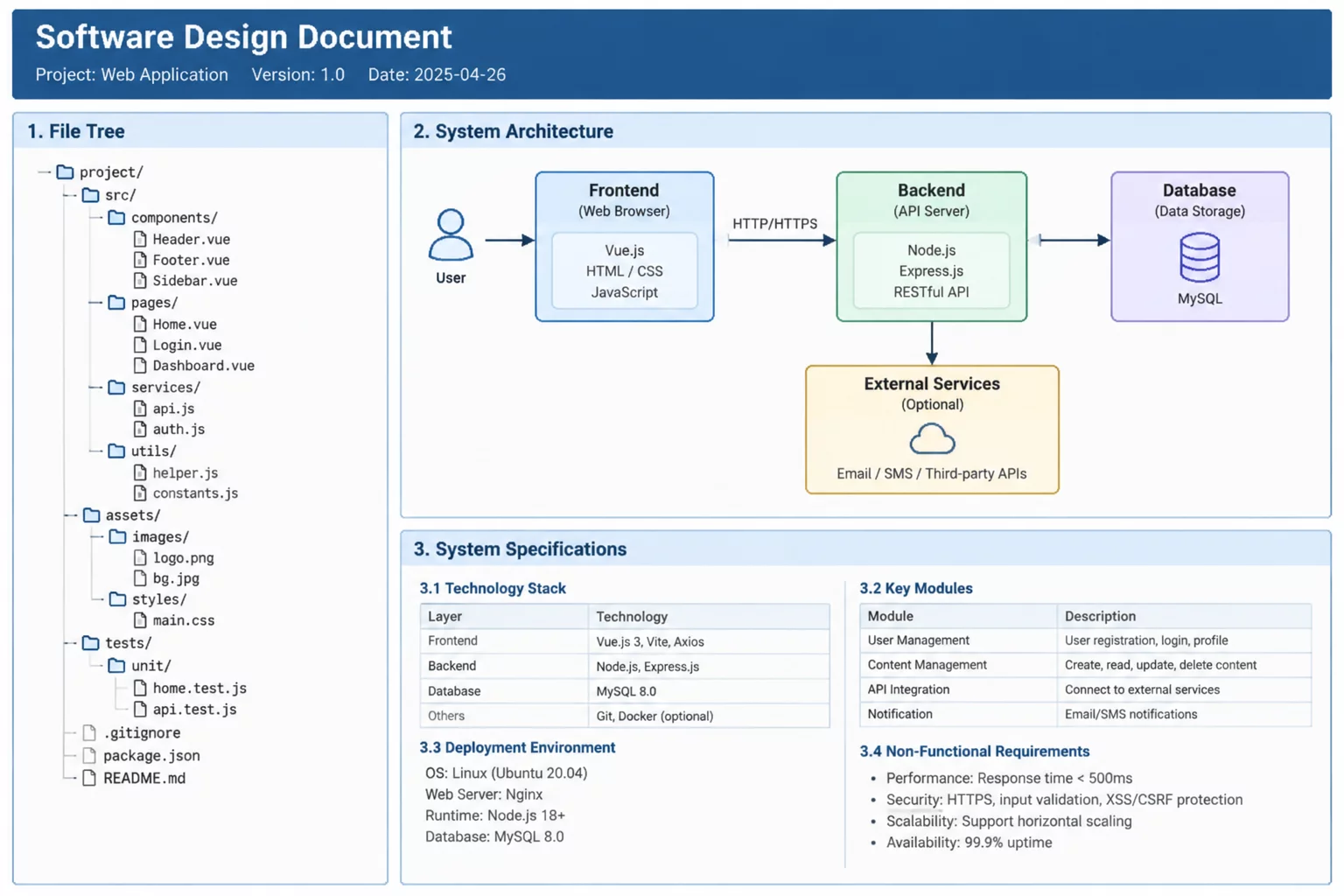
Automated documentation engines have shifted how development teams translate evolving source repositories into auditable architectural roadmaps. Without strict conventions, machine-generated folder trees quickly degrade into unreadable dumps of thousands of auxiliary files. DocuWriter.ai addresses this challenge by formalizing structural tree specifications inside modern Software Design Documents, establishing deterministic rules for directory depths, interface isolation, and semantic package mapping.
Structural Anatomy of Automated Directory Blueprints
A Software Design Document must articulate not just file presence, but architectural ownership and data flow. When DocuWriter.ai reads a code workspace, it evaluates every directory against strict taxonomy rules. Root-level configurations such as toolchain manifests, continuous integration recipes, and dependency locks remain distinctly separated from functional source trees. This separation allows engineers and static analyzers to verify infrastructure footprints before diving into application business logic.
In large-scale codebases, indiscriminate directory traversals overwhelm human reviewers and AI prompt tokens alike. The standardized format resolves this bottleneck by implementing context-aware depth limits. Leaf directories containing repetitive boilerplate, such as localized translation catalogs or generated schema types, collapse into annotated single nodes. As a result, critical entry points, internal orchestration handlers, and data persistence boundaries stand out with maximum visual clarity.
- Explicit boundary demarcation separating domain services, transport layers, and infrastructure clients.
- Deterministic two-depth pruning with inline comment annotations denoting cross-module contracts.
- Automated linting flags identifying unmapped test suites, orphaned fixtures, and stray configuration files.
When autonomous engines draft technical architecture, the file tree serves as the verifiable bedrock between abstract requirements and executable filesystem layout.
Monorepo Workspaces and AST Parsing Boundaries
Complex monorepo architectures demand higher rigor than standalone repositories. DocuWriter.ai solves this by executing modular AST parsing across individual package manifests, generating localized tree subsections rather than one monolithic filesystem hierarchy. Shared libraries, internal tooling, and microservice definitions maintain their own self-contained tree blocks inside the primary design documentation, ensuring that cross-package dependencies remain explicitly visible to development teams.
Integrating these documentation standards into CI/CD validation pipelines ensures that file structures never diverge from published technical specs. If a newly created pull request introduces novel top-level folders or bypasses established interface isolation directories, automated checks flag the violation against the DocuWriter schema. This proactive governance preserves architectural integrity over multi-year software maintenance lifecycles.
Frequently Asked Architectural Inquiries
The engine utilizes scoped package manifest boundary analysis. Instead of dumping recursive paths for thousands of build artifacts, it generates isolated sub-trees for independent workspaces while annotating shared contract boundaries.
DocuWriter.ai formats directory layouts using standardized UTF-8 box-drawing characters inside structured Markdown blocks, accompanied by YAML metadata tags indicating whether nodes are application modules, shared packages, or unit tests.
Yes. Teams integrate linting checks into GitHub Actions or GitLab CI to ensure newly committed files comply with the canonical structure outlined in the repository Software Design Document before passing quality gates.