
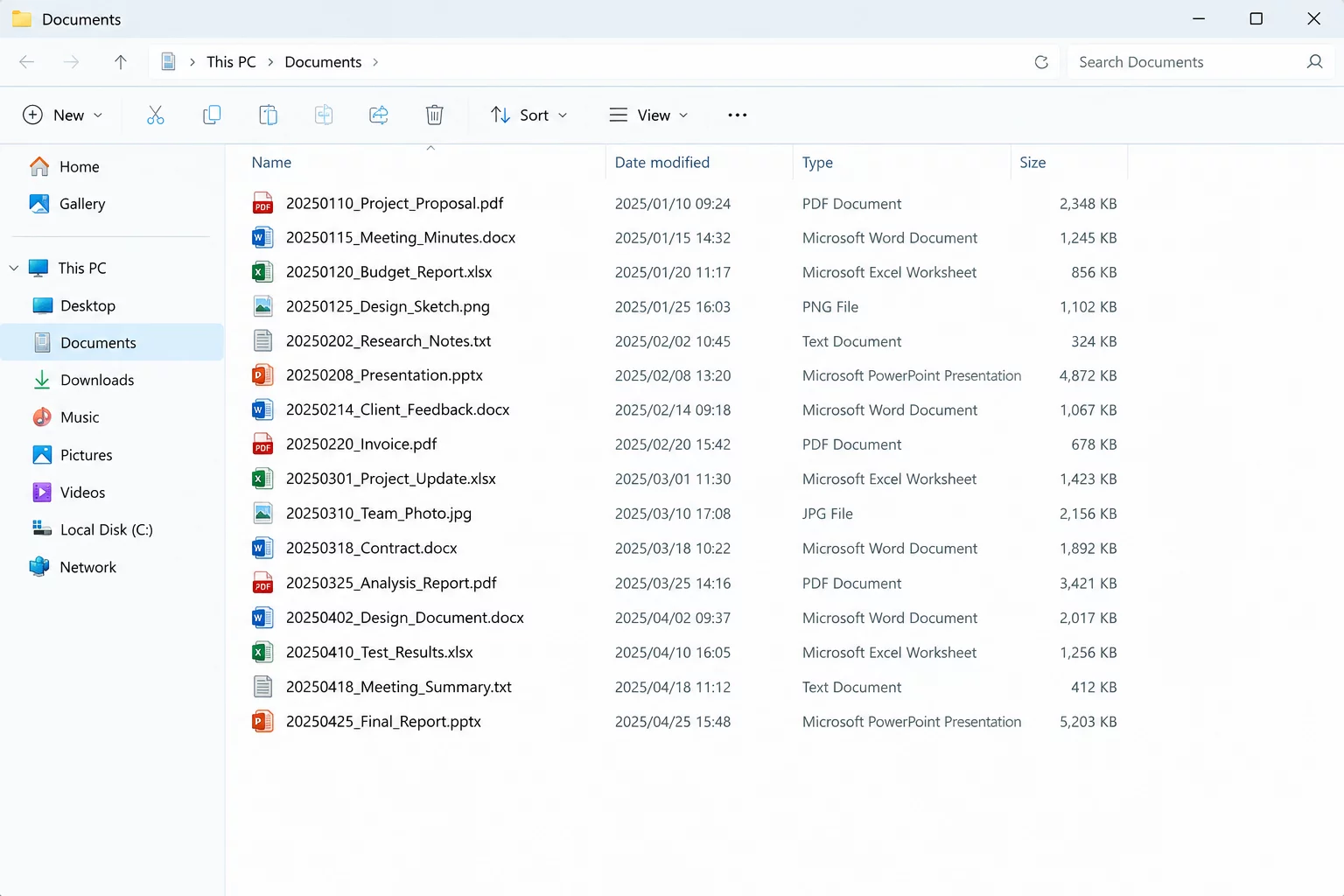
Filesystems differ significantly in how they handle creation timestamps, character encoding normalization, and path segment delimiters. When assets migrate between macOS APFS, Windows NTFS, and Linux ext4, filesystem-level metadata frequently degrades or resets. By anchoring the file identity to a strict standardized date prefix, teams achieve deterministic chronological order independent of external filesystem attributes.
Lexicographical Alignment Across Kernel Boundaries
The core mechanism behind standardized date prefixing is the convergence of alphabetical sorting and temporal sequence. When formatted as four-digit year, two-digit month, and two-digit day (YYYY-MM-DD), the ASCII character code ordering corresponds directly to time progression. This property guarantees that default directory listings in bash, PowerShell, Finder, and file explorers arrange assets in identical chronological order without requiring active metadata queries.
Separating the date token from the descriptor token requires disciplined character selection. Avoiding whitespaces, colons, slashes, and reserved shell symbols ensures automated CLI tools like rsync, robocopy, and git operate seamlessly without escaping or quoted argument wrappers.
- Zero-padded ISO-8601 date token (YYYY-MM-DD) placed at index zero of the file basename.
- Single hyphen or underscore delimiter isolating metadata tags from project identifiers.
- Strict lowercase ASCII alphanumeric characters preserving case-sensitivity parity between Linux and Windows.
Filesystem timestamps are transient artifacts of copy operations, but an ISO-8601 prefix baked into the filename creates an immutable chronological contract across every operating system.
Automating Ingestion and Version Segmentation
In distributed engineering organizations, automated sync jobs and continuous delivery artifacts generate thousands of files weekly. Integrating date prefixes into continuous integration workflows eliminates version clashes by design. When secondary resolution is needed for multiple builds on a single date, appending an incremental patch counter or a compact UTC timestamp prevents filename collisions while preserving exact sort sequence.
Adopting this canonical taxonomy transforms unstructured folder heaps into self-documenting timelines. Archive cleanups become trivial shell one-liners, enabling engineers to isolate quarter-old or year-old datasets using straightforward globbing patterns rather than unstable file attribute lookups.
Prefix Standard Clarifications
Only big-endian formats (year first, then month, then day) sort naturally in true chronological sequence when evaluated alphabetically by standard filesystem algorithms. Middle-endian or little-endian orders scatter consecutive days across mismatched years.
For intra-day fidelity, append UTC military time formatted as -HHMMSS without colons, such as 2026-01-30-143000-audit-report.pdf, avoiding colon characters which are illegal on Windows NTFS.
A single hyphen or underscore is universally supported across POSIX shells, Windows CMD, and cloud storage object keys, preventing unintended path truncation or string splitting errors.