
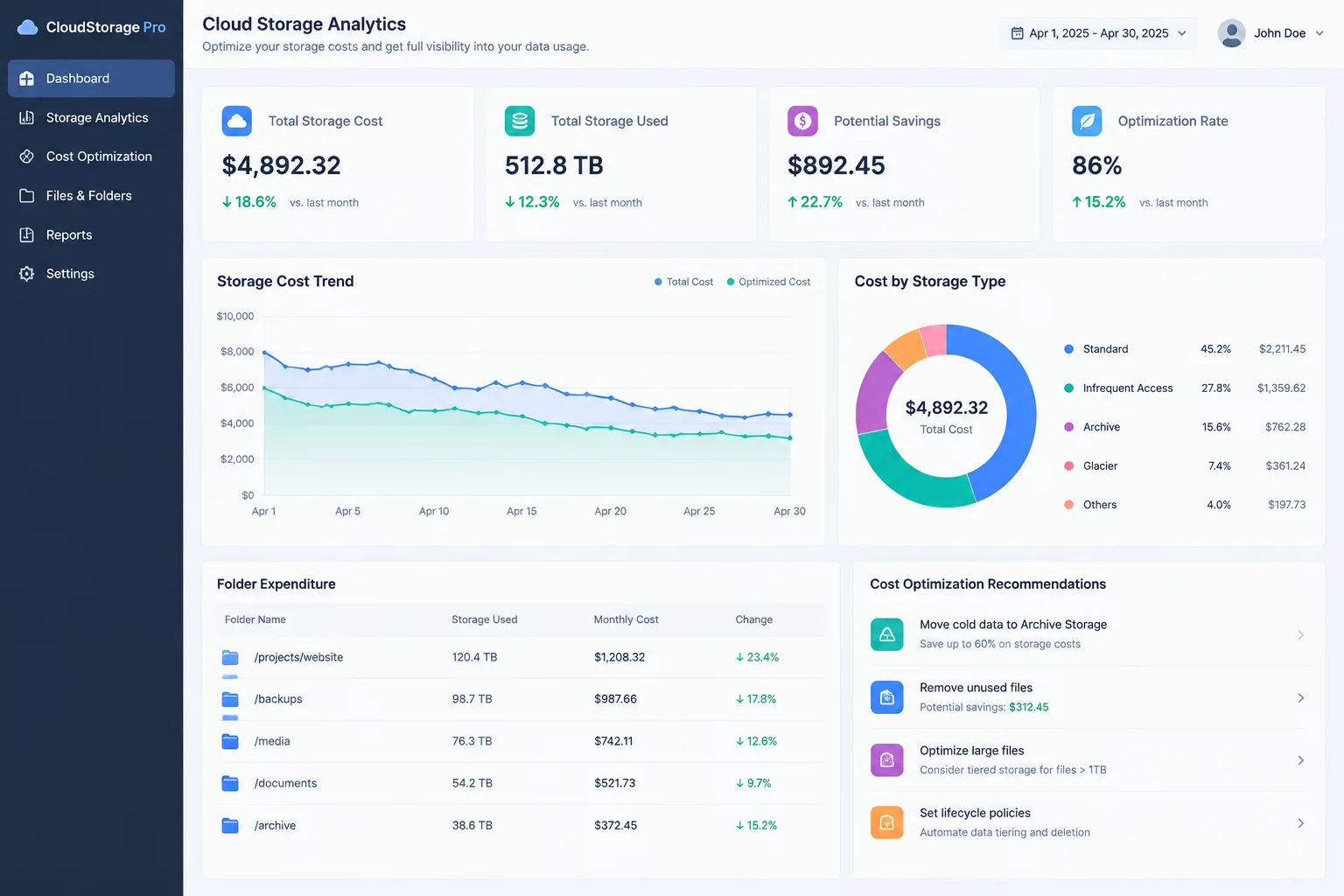
Unchecked storage growth in enterprise cloud environments rarely stems from raw business data alone. It thrives within forgotten sandbox buckets, unmonitored multipart upload scraps, unexpiring object version histories, and untagged intermediate prefixes. When modern enterprises operate dozens of autonomous engineering squads, shared storage repositories turn into financial blind spots. Purpose-built cost governance tools give infrastructure architects the continuous observability and programmatic rule enforcement needed to reclaim budgets without stifling developer productivity.
Structural Cost Drivers in Deep Cloud Folder Taxonomies
Object storage architectures decouple data volume from directory trees, yet applications invariably construct logical hierarchies through delimited prefixes. Over time, standard analytics tools fail to parse billing impact at this sub-bucket tier. Operational costs silently surge from high-frequency read and write requests on poorly indexed subfolders, high-cost standard tiers hosting dormant test datasets, and redundant cross-zone sync routines that trigger massive ingress and egress fees.
Governance platforms dismantle this obscurity by intercepting storage telemetry and aligning physical byte counts with organizational cost centers. Instead of waiting for consolidated monthly invoice surprises, teams can identify specific prefixes generating non-linear fee trajectories and instantly initiate remediation playbooks.
- Granular Prefix-Level Metering: Categorizes expenditure across deep folder hierarchies without imposing manual tagging overhead on engineering workflows.
- Automated Tiering Transitions: Shifts inactive historical archives from Hot to Cold, Glacier, or Archive tiers based on verified read cadence metrics.
- Orphaned Object Reclamation: Automatically purges incomplete multipart uploads, stale snapshots, and deleted marker trails after predetermined expiration windows.
Without rigid prefix taxonomy and automated lifecycle governance, unstructured cloud storage invariably drifts into an unmetered, multi-million dollar corporate liability.
Deploying Policy Guardrails and Automated Chargeback Cycles
Effective implementation relies on codifying storage governance directly into Infrastructure-as-Code workflows. When provisioning object containers through Terraform or OpenTofu, governance tools enforce required metadata tagging, baseline lifecycle transition rules, and strict encryption configurations before resources reach runtime environments. Any unapproved provisioning event triggers automatic policy warnings or immediate isolation routines.
At the operational level, governance software computes true cost-to-serve metrics by synthesizing storage capacity with egress, compute, and data-retrieval expenses. This level of granularity facilitates automated chargeback matrices, enabling finance and platform engineering teams to assign line-item financial accountability to individual departments, product lines, and continuous delivery pipelines.
Frequently Answered Governance Questions
Object storage providers like AWS S3 and Google Cloud Storage do not organize physical directories natively; they parse string prefixes. When teams structure prefixes using uniform business identifiers (such as /bu-analytics/project-omega/raw-telemetry/), governance analyzers calculate expenditure by prefix without needing to query billions of individual metadata tags, reducing analysis run-times from hours to seconds.
When versioning is enabled on active buckets, overwritten or deleted files persist indefinitely in the primary tier as non-current objects unless targeted by explicit expiration policies. In high-frequency ingestion streams, these unseen superseded files can multiply total billed gigabytes by three to ten times the visible working dataset.
Transitioning should occur once object access frequency drops below once every 90 days, taking into account minimum retention windows and retrieval penalties. Cold tiers offer up to 90% savings on base capacity, but unexpected bulk reads or premature deletion within the minimum duration will trigger penalty charges that negate the initial cost advantage.